Micromobility Commission Report
Written by MassBike
March 12, 2026

In November 2024, as part of the economic development bond bill, the state legislature created the Special Commission on Micromobility to focus on three key areas: classification, regulation, and expansion. First convening in April of this 2025, the Commission met five times through the end of December to discuss the current status of micromobility use and rules across the Commonwealth. Along with MassBike and our advocacy partners from WalkMass, the Commission had 15 members including secretariats, policy makers, public safety officers, advocates, and innovators. We heard from experts on topics related to battery fire safety, discrepancies related to classification and enforcement, and incentive programs to expand the daily use of micromobility. We want to thank the Chairs of the Joint Committee on Transportation and the MassDOT team, specifically the staff of The Lab, for their skillful stewardship of a complex and comprehensive process. After nine months of work and discussion, we are pleased to present the Commission’s final report.
At the onset, the Commission recognized the importance of our charge to address several of the existential crises facing our Commonwealth, including roadway congestion and motor vehicle pollution: Massachusetts ranks fifth in the nation for roadway congestion, despite being third in capital and bridge spending per mile. Our overall performance ranks 48th among the states, with the average person spending 93 hours in traffic annually, and our transportation sector remains the state’s largest source of greenhouse gas emissions, accounting for roughly 37% of the total—putting serious pressure on our ability to meet our mandated 2050 climate goals.
Micromobility presents a solution to many of these challenges: in Massachusetts, 57% of all trips are three miles or fewer—a typical biking and scooting distance for many people—and yet 80% of those trips are currently made in automobiles. Increasing the use of micromobility for short trips can reduce congestion and emissions statewide, while delivering meaningful benefits such as improved physical and mental health, greater affordability and independence, and expanded access to the Commonwealth’s natural resources.
The Commission’s charge, then, was to provide a framework of regulatory and incentive recommendations for the legislature and administration to act upon to accelerate the adoption of micromobility in a safe, sensible, and comprehensive way. By enabling and encouraging new ways to move around, we can begin to meaningfully address the real mobility challenges we face.
Our recommendations aim to enhance safety on roads and pathways while improving accessibility and affordability for everyone, including those most vulnerable—such as older adults, youth, and people with disabilities. Micromobility should be proactively integrated into the Commonwealth’s transportation system, rather than managed through reactive and fragmented regulations, to ensure that all users—regardless of speed or device—can share space safely and harmoniously.
This requires consistent standards so that regulators, law enforcement, policymakers, planners, retailers, and consumers share a clear understanding of how to move Massachusetts forward to a cleaner and less congested future. In the near term, we propose a tiered classification system for micromobility devices based on top speed, along with simple, effective data metrics to track usage and crashes. Looking further ahead, we outline strategies to expand adoption through innovation, design guidance, infrastructure investment, education, and targeted public funding. This report is an important first step that we hope will inform timely legislative and administrative action to bring clarity, consistency, and direction for micromobility policies in the Commonwealth.
You can read the full 117 page report here.
The Commission’s Report was filed with the Legislature, with the following recommendations:
- Recommendation 1: Legislative and Regulatory Changes: The legislature should add the necessary legal definitions to Massachusetts General Law and update all existing relevant definitions or remove those that are no longer relevant.
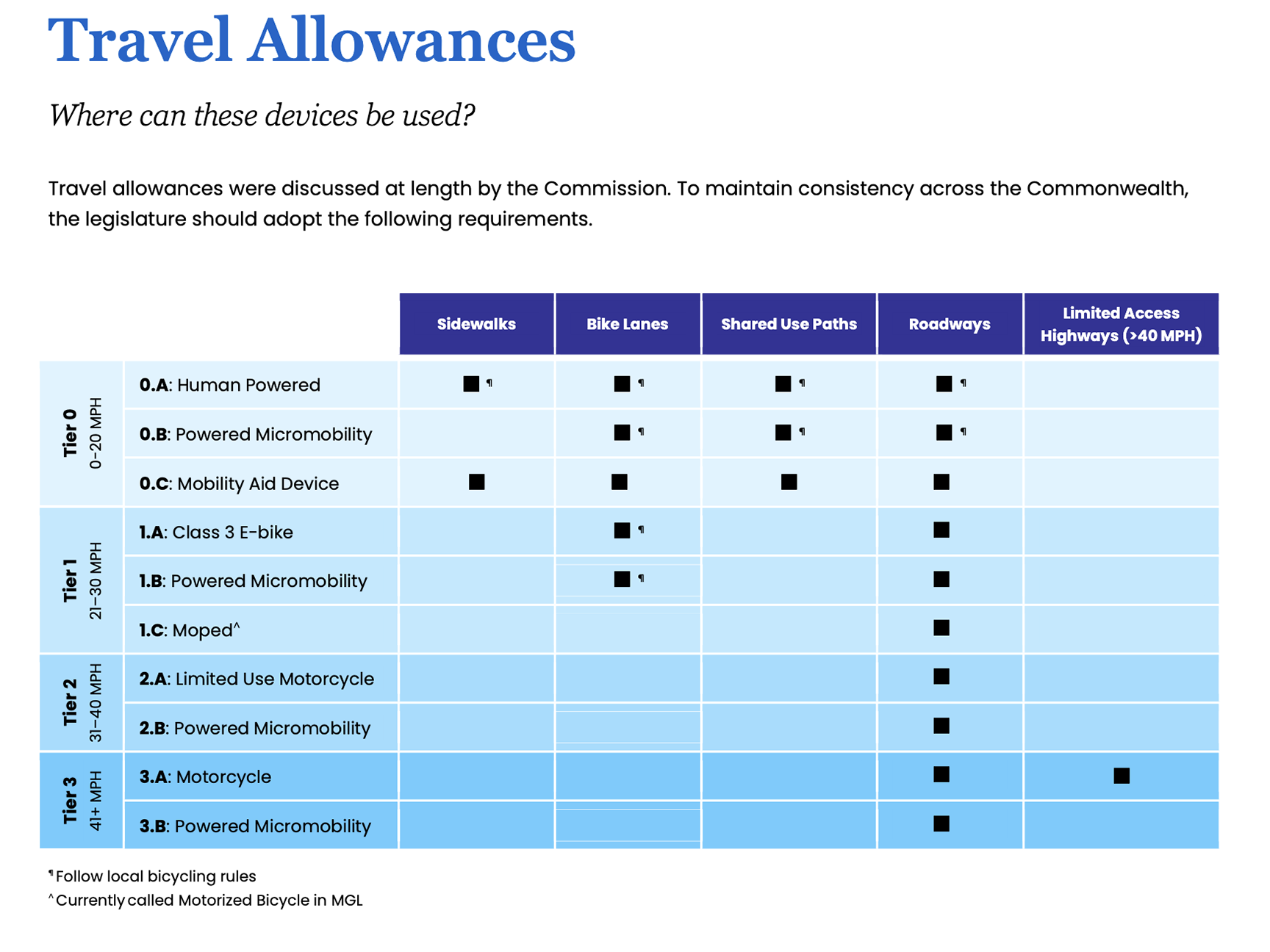
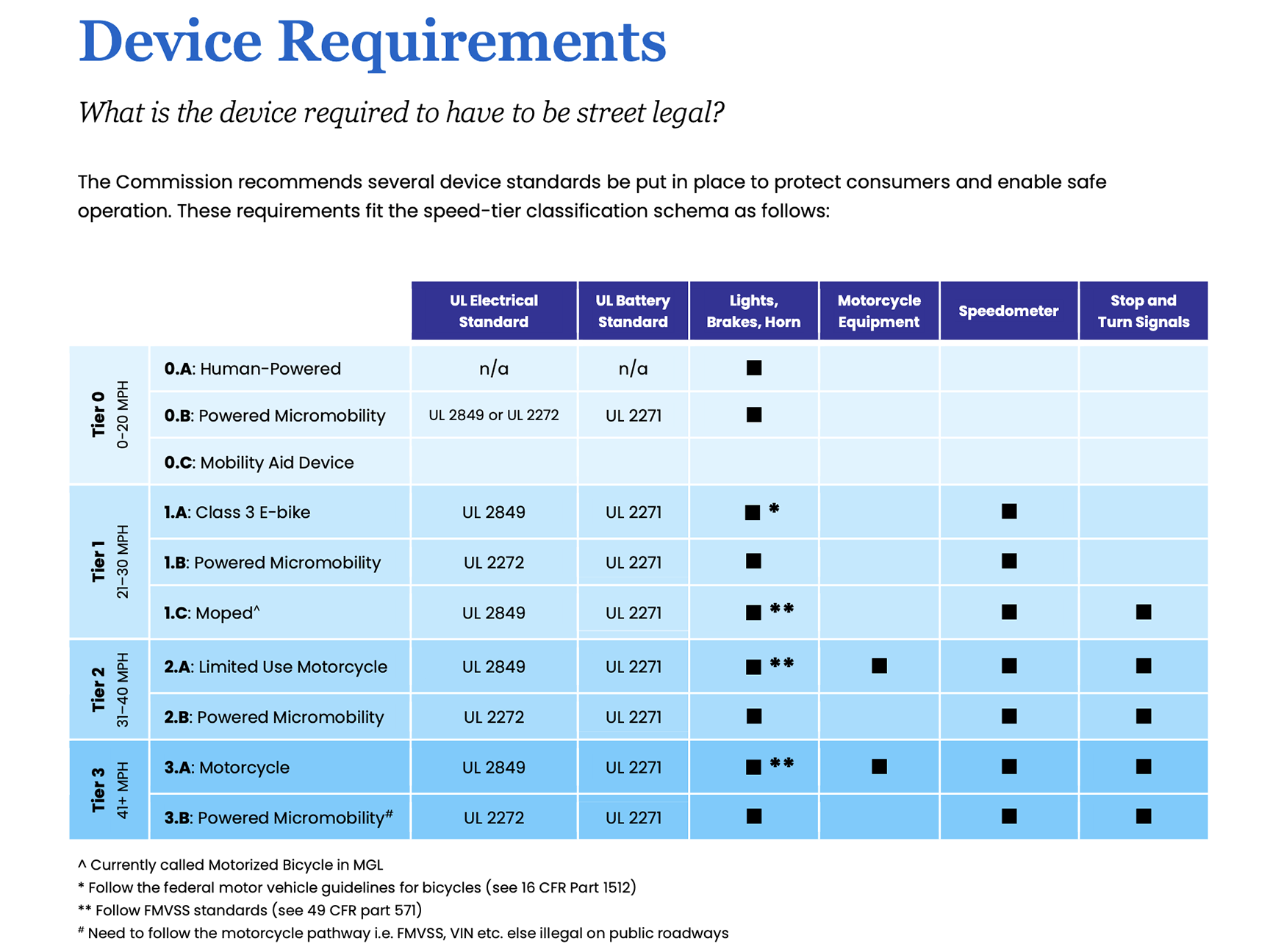
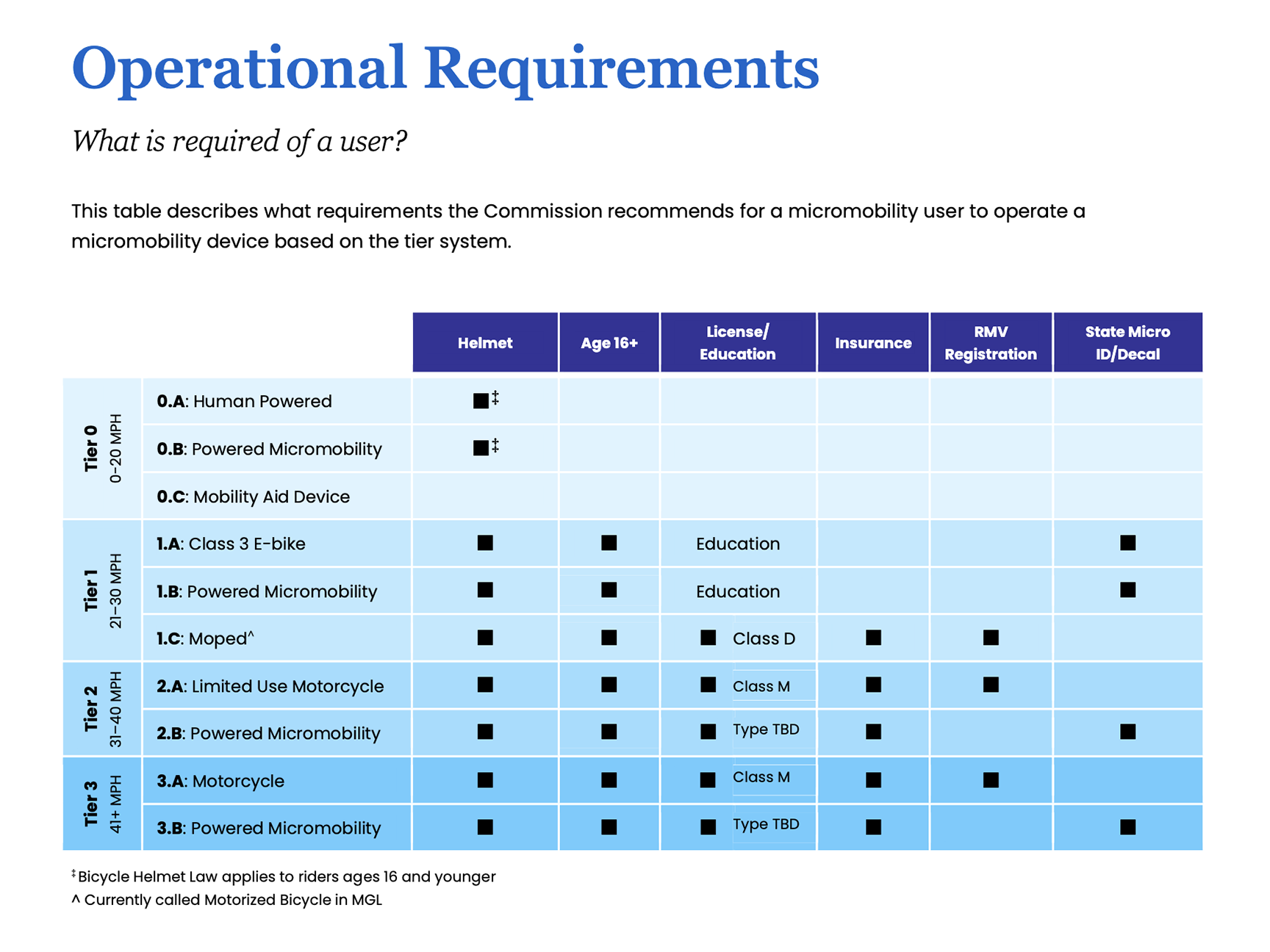
- Recommendation 2: Speed-Based Classification Schema: The Commission recommends that the legislature adopt a methodology to classify micromobility devices; define requirements for operating a device based on its classification; place restrictions on where a given device can be operated; define what standards a device should be manufactured to; and devise a way to identify an individual device.
- Recommendation 3: Micro ID: The legislature should establish a time-limited working group with funding to design a statewide Micro ID Decal pilot. This will convene a multi-agency working group to develop a light-touch micromobility identification framework using a tamper-evident decal that links to a record confirming device tier, basic safety compliance, and limited, opt-in personally identifiable information for authorized parties.
- Recommendation 4: Police Training: The Massachusetts State Police Academy and the Massachusetts Police Training Committee should develop and deliver training for law enforcement officers, consistent with new and current micromobility laws, regulations and guidelines.
- Recommendation 5: Crash Report and Vulnerable User Data: The legislature should amend state law to enable the inclusion within MassDOT’s crash data system of micromobility-involved crashes that don't also involve an operated motor vehicle.
- Recommendation 6: Default Maximum Speed on Paths: The legislature should establish a default maximum speed of 20 MPH on shared use paths, applicable statewide, unless otherwise posted. Path-operating entities retain the authority to lower the limit based on context-specific factors such as user volume, path width, crossings, geometry, adjacent land uses.
- Recommendation 7: Education Campaign: Law enforcement and state and local stakeholders, such as Safe Routes to Schools, should collaborate with relevant community partners, such as local bike shops, to develop and deliver an educational campaign to inform micromobility users about laws, regulations, local ordinances, & safety practices.
- Recommendation 8: Automated Enforcement: The legislature should authorize automated enforcement on infractions that impact vulnerable users, such as speeding, the improper use of bus and bike lanes, and red light running.
- Recommendation 9: Model Municipal Traffic Control Ordinance: MassDOT should include model micromobility traffic control regulations and prohibitions on obstructing bicycle lanes in its Sample Regulation for a Standard Municipal Traffic Code.
- Recommendation 10: Design Guidance: MassDOT and DCR should develop context-sensitive design guidance for state and municipal trails and shared-use paths that establishes recommended design parameters: addressing the separation of pedestrian and wheeled modes, design speed, signage, and emerging-micromobility, incorporating variations appropriate to urban, suburban, and rural contexts.
- Recommendation 11: Micromobility Integration: The MBTA and other RTAs should adopt and implement a micromobility integration plan.
- Recommendation 12: Funding for Upgrades: The legislature should increase appropriations for existing state programs, particularly the Complete Streets Funding Program and the Shared Streets & Spaces Program, to further assist municipalities in expanding their networks and transitioning from interim infrastructure treatments.
- Recommendation 13: Expand Bikeshare: The legislature should establish a reliable and sustainable funding mechanism to support publicly owned, docked micromobility share systems. A combination of formula-based operating support and competitive grants for system expansion should be explored.
- Recommendation 14: Fund More E-bike Subsidies: The legislature should fund, and MassCEC should expand, the statewide e-bike rebate program.
- Recommendation 15: Commercial Use Micromobility Study: The legislature should allocate funds for MassDOT to commission a study from an academic partner to understand how micromobility is used in commercial settings, particularly in the package delivery and food delivery industries.
- Recommendation 16: Presumed Liability Study: MassDOT should work with an academic partner to study the hierarchy of responsibility in a crash and the potential effects of introducing a “Presumed Liability” law.
Below is a summary of the classification, regulatory, travel allowance recommendations. Note, these are not set in any rules, but are a framework for us to pursue our work in the legislature and with the administration.