
Testimony Transcript for Micromobility Hearing
Written by Galen Mook
June 04, 2026
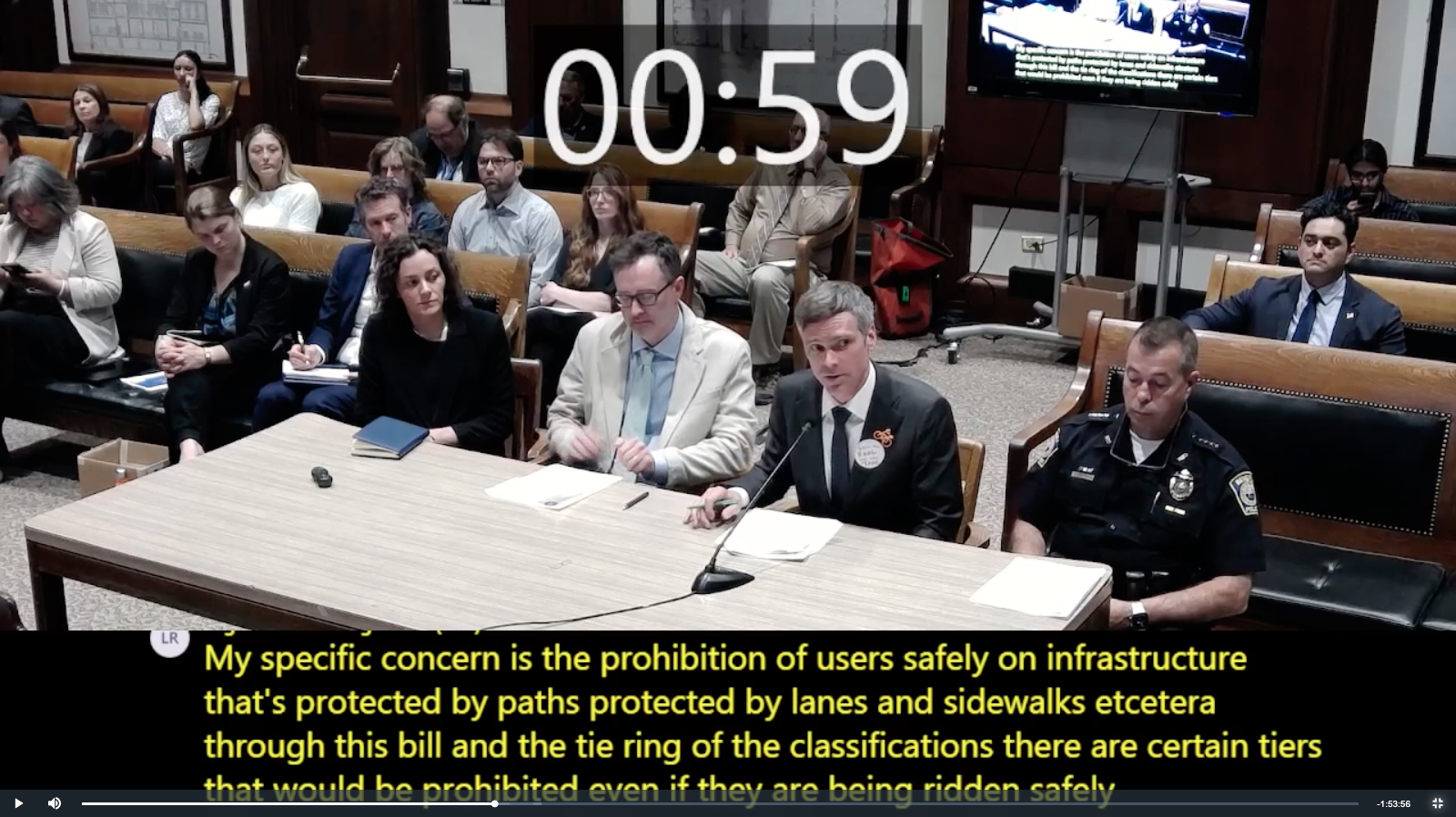
This testimony was shared at a Joint Committee of Transportation Hearing on May 28, 2026 as part of a panel with people that took part in the Micromobility Commission: (L to R) The Ride Cafe’s Kara Oberg, WalkMassachusetts executive director Brendan Kearney, MassBike executive director Galen Mook, and Beverly Police Chief Chief John G. LeLacheur.
Regarding S.3077. An Act to enhance the safe use of micromobility devices:
This is a very important bill. We've been putting a lot of work into it based on your recommendation to form a Special Commission on Micromobility, which we reported out in January. Thank you to both of the Chairs for participating in that process.
The Commission came out with 16 recommendations, some of which are addressed in this bill. But we also feel there are lots of recommendations that are still yet-to-be ironed out. So we appreciate that there is future work detailed in this bill to form commissions to continue to work on these stickier issues.
In this Commission we were identifying three major purposes of classification, regulation, and expansion. Those were the three tasks that you charged us with. And through the Commission recommendations we came out with roughly three main areas of: device requirements, travel restrictions, and operational requirements. And I think it’s important to differentiate the three because we’re going to tackle the three differently through different types of regulations and legislation.
The report is very dense and complex, and we certainly appreciate the speed-based criteria (for classification). We think it’s sensible and clear, future proof, makes it easy for identification for retail purposes, for enforcement purposes, etcetera.
I’ll speak for myself and for MassBike in that we still have more work to be done on the operational requirements and specifically the travel restrictions that we are seeking from this work. My specific concern is the prohibition of users, safely, on protected infrastructure: bike paths, protected bike lanes, sidewalks, etc. Through this bill, and the tiering of the classifications, there are certain tiers that would be prohibited even if they are being ridden safely.
And what we have seen, and shown just at the micromobility demo day at the State House just the other day, is that someone on a one-wheel can still operate safely on a sidewalk if they go less than 5mph, even if the device itself does have the capability of going 35mph. So the idea is that a user based restriction is what I am hoping we can come out with, and not a device based restriction.
If we are going to force vulnerable users who are on micromobility devices onto the roadways and off of the safe infrastructure, we are going to keep people from using these devices. People are not going to feel comfortable if they can only operate in traffic. This is counter to one of the charges of the commission, which is expanding use and doing so sensibly.
Instead I recommend that the Commission further studies how we can do travel restrictions. But also one of the recommendations we came out with was a statewide default speed limit on pathways. If one of the calls is that we don’t want a device above 20mph on the pathways, then we should have a default speed limit on the pathways clearly defining that you should not ride above 20mph – or if a local jurisdiction wants to lower that, by all means that process exists and is within their purview.
We don’t treat other private vehicles in this prohibitive sense. As Rep. Owens mentioned, he can drive his Prius in a school zone, as long as he keeps it below 20mph. So the tagline I’d really like us to keep here for the framework of the future of transportation, the framework I want us to follow is: blame the fool and not the tool.
